
How Forest Avenue Became MLK Boulevard in Dallas
In 1981, Dallas renamed Forest Avenue as Martin Luther King Jr. Boulevard, driven by councilwoman Elsie Faye Heggins' vision for South Dallas.
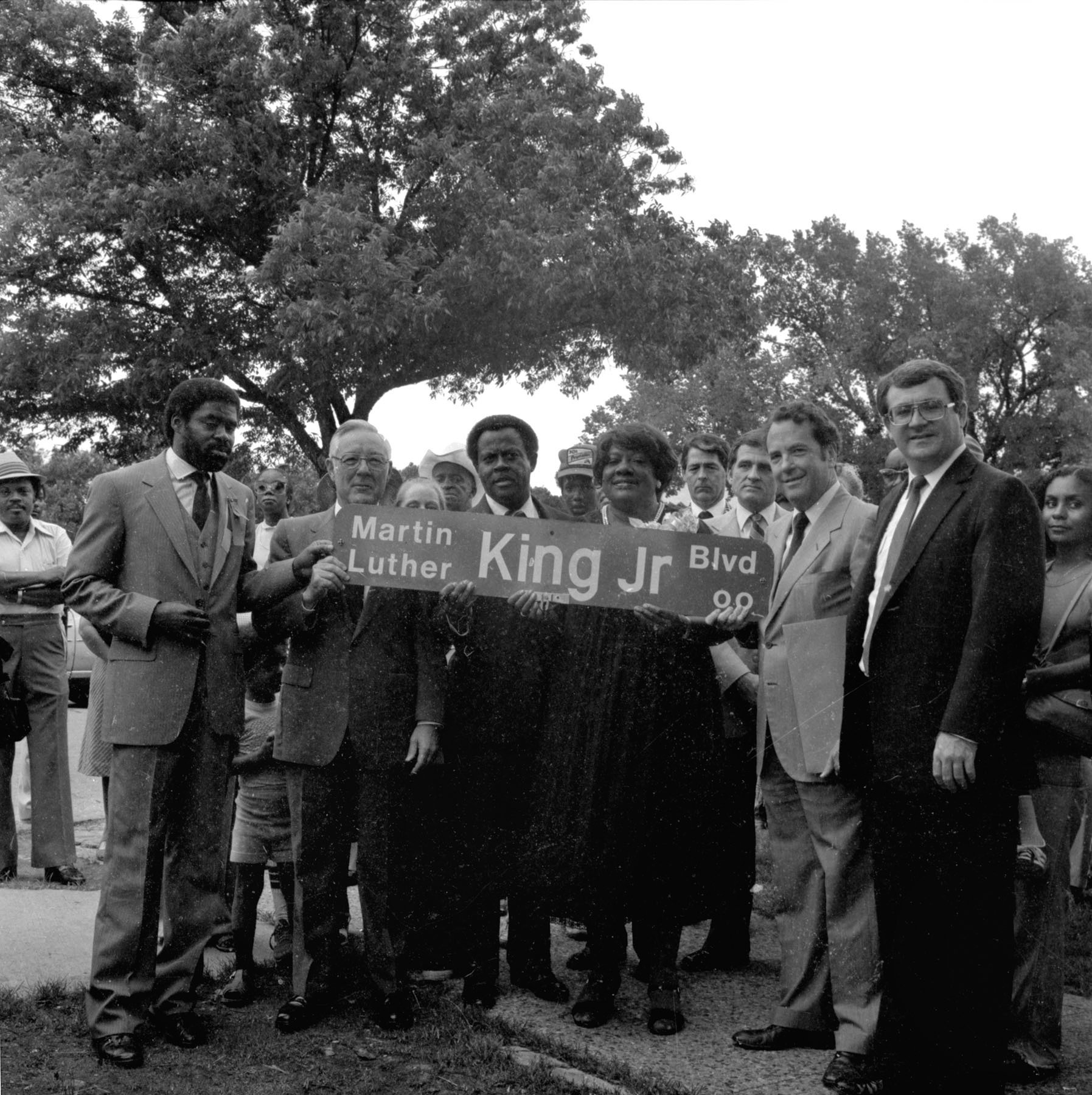
The Dallas City Council voted on April 8, 1981, to rename Forest Avenue as Martin Luther King Jr. Boulevard, a decision that marked one of the most consequential street-naming battles in the city’s history.
The vote didn’t come from nowhere. It grew directly from the political rise of Elsie Faye Heggins, who won her Dallas City Council seat in 1980 and arrived with a blueprint for reshaping South Dallas into something that reflected the community actually living there. Her ambitions ran far beyond a single street. According to scholar Edward Sebesta’s document “Struggles Over Street Names in Dallas,” Heggins proposed renaming Highway I-45 as Ralph Bunche Freeway, State Highway 352 as Frederick Douglas Blvd., Oakland Ave. as Malcolm X Avenue, and at least one major corridor, including Forest Avenue, Kiest Blvd. or Cedar Crest Blvd., as Martin Luther King Jr. Blvd. The map Sebesta included in his work is titled “Elsie Faye Heggins’ Vision,” which tells you something about the scale of what she was after.
She thought big.
The Forest Avenue renaming was the first domino. That stretch of road serves as a primary gateway to Fair Park and Oak Cliff, and transforming it into Martin Luther King Jr. Boulevard was understood by South Dallas residents as something more than municipal housekeeping. It was a declaration about who the neighborhood belonged to, who its history honored, and whose names deserved to be embedded in the daily geography of the city.
“What we name our streets, schools and civic structures, and the point in time at which we make these decisions, reflects an ongoing struggle to control and participate in the political, cultural and social narrative shaping of a city,” Dallas Free Press reported in its examination of the Heggins legacy and South Dallas’ long fight for self-determination.
That fight had a foil, and it came from close to home. Richard Spencer, the man widely credited as the creator of the so-called “alt-right” movement, was raised in Preston Hollow and attended St. Mark’s School of Texas. On Aug. 11, 2017, Spencer helped organize the tiki-torch march at the University of Virginia campus in Charlottesville, where white nationalists chanted “You will not replace us” and “Jews will not replace us” as they moved through the grounds. Police eventually forced the group out. The following day, a much larger group gathered for the “Unite The Right Rally” at Charlottesville’s Robert E. Lee Park, where violent clashes with counter-protesters left dozens injured. The rally had been triggered by the city council’s vote to remove the Confederate General Robert E. Lee statue from that same park.
The through line between Charlottesville’s Confederate statuary fight and the street-naming battles Heggins waged in South Dallas decades earlier isn’t hard to draw. Both contests were, at root, arguments about whose story a city chooses to tell with its public spaces. Heggins understood that in 1981. The Dallas Public Library’s Dallas History and Archives Division, which holds photographs of Heggins and other residents lifting the new Martin Luther King Jr. Boulevard street sign in June 1982, preserves that understanding in its collections.
That photograph matters. It shows a community that didn’t wait for permission to see itself reflected in the infrastructure it lived beside every day. South Dallas residents took the argument to the council chambers and won, at least on Forest Avenue, even as Heggins’ broader vision for the Ralph Bunche Freeway and the Frederick Douglas Blvd. designations remained unfinished business.
The City of Dallas open data portal and city records confirm the April 8, 1981 ordinance remains in effect, and Martin Luther King Jr. Boulevard still runs through South Dallas today, connecting Fair Park to Oak Cliff and carrying the name Heggins helped put on it more than four decades ago.